
On any busy worksite, safety is one of the most important priorities. Clear, visible signals help prevent accidents by guiding both workers and passing vehicles. Just like essential construction equipment, traffic lights play a vital role in keeping everything organised and moving safely.
Without them, even simple site operations can become confusing or unsafe, as vehicles and pedestrians compete for space. In this environment, the right traffic light controller helps control traffic flow and keeps your site compliant with safety rules. Choosing the right setup is about matching the technology to your site’s layout, traffic levels and working hours.
Types of Traffic Lights

Fixed Period
This system operates on a constant timer, cycling through green, amber and red phases at set intervals. It does not change based on how many vehicles are present but remains steady and predictable. A fixed period traffic light controller is often used in smaller or low-traffic work zones where movement patterns are regular and easy to monitor. Because it runs on a fixed schedule, it is simple to set up and maintain. Although it’s simple to install and operate, it may not be efficient for sites with irregular or changing traffic volumes.
Fully Triggered
The fully triggered system relies completely on sensors or cameras. These detect movement on all approaches and adjust signal changes dynamically based on real-time conditions. Although it can be more costly to install, it improves responsiveness and efficiency at complex work sites where traffic patterns vary throughout the day. It can reduce delays at busy intersections and adapt quickly to sudden changes in traffic.
Vehicle Triggered
A vehicle-triggered light system uses sensors to detect when a car or truck is waiting at an intersection or entry point. Once a vehicle arrives, the lights change automatically to allow passage. This system can reduce waiting times and prevent unnecessary stops when there is little or no traffic. For work sites with light or moderate activity, it offers both convenience and improved traffic flow. It is especially useful where traffic is sporadic and does not arrive in regular waves.
Semi-Triggered
This type of system works partly on a timer and partly on sensor input. The main road may run on a fixed cycle, while the secondary road changes only when vehicles are detected. Semi-triggered traffic warning lights are common near smaller worksites on busy roads, as they balance automation with control. This setup keeps the main road moving smoothly while still responding to traffic on the side road when needed. It is a good middle ground between fully fixed and fully triggered systems.
Types of Traffic Signals
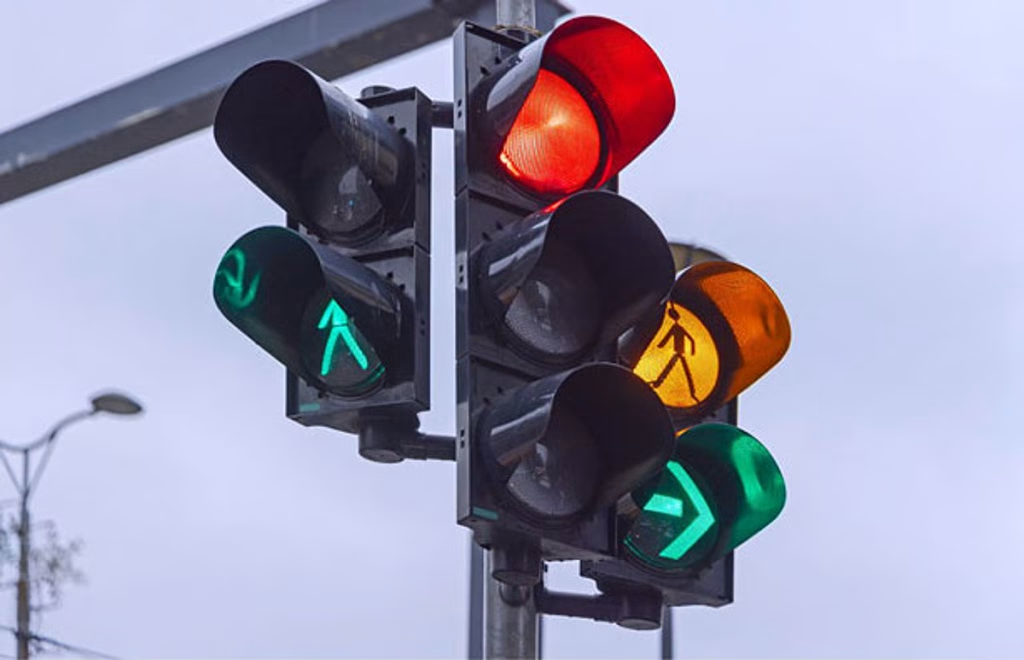
Traffic Actuated
In this type, the signal responds automatically to the volume and flow of vehicles approaching the intersection. Detectors in the road or nearby sense movement and change the signal once traffic builds up. This type is energy-efficient and well-suited to temporary or mobile sites. It works well with a programmable traffic light, allowing flexible timing that suits your site’s needs. It is particularly useful where traffic levels change between peak and off-peak hours.
Manually Operated
These signals are controlled by an operator rather than a timer or sensor. A trained worker manually changes the lights according to site activity or changing road conditions. This option is useful during maintenance periods, emergency works or where traffic patterns change frequently. Manual operation gives flexibility but requires constant supervision. It is often used in short-term projects or where conditions are too complex for full automation.
Pedestrian
Pedestrian signals are designed to manage foot traffic around or across a work site. They are important in areas near public footpaths, schools or transport hubs where people are present. These signals can run on a timed schedule or through push-button activation, helping ensure safe crossing while minimising vehicle delays. Push-button signals give pedestrians more control, while timed signals keep traffic moving in a predictable way. They also work best when used with reliable traffic LED lights, which are brighter and more efficient than traditional bulbs.
Special/Flashing Signals
Some worksites require special or flashing signals to warn drivers about specific hazards such as lane closures, heavy machinery or restricted zones. These are often used in combination with traffic warning lights to draw attention and communicate changing conditions clearly. Flashing amber signals are common in temporary roadworks or detour routes, where the focus is more on alerting than on controlling the flow. They can be mounted on temporary poles or mobile barrier units and are easy to relocate as the work area shifts.
Final Words
Choosing traffic lights for a worksite is not a one-size-fits-all decision. Each project has different demands based on size, duration and traffic volume. Fixed systems may suit smaller areas, while fully triggered or actuated lights are better for complex, high-traffic environments. Before installation, consider factors like visibility range, energy use and durability.