
Except for the flagship Thunder, the Mazda BT-50 lineup skips factory-fitted front protection. For drivers tackling unsealed tracks or loaded work routes, an aftermarket bar is crucial to shield the lights, grille, and engine bay. BT-50 owners can spend a premium and have nudge and bull bars fitted at dealerships, or get more value with aftermarket options that also include premium features such as integrated light bars.
Nudge Bar Basics
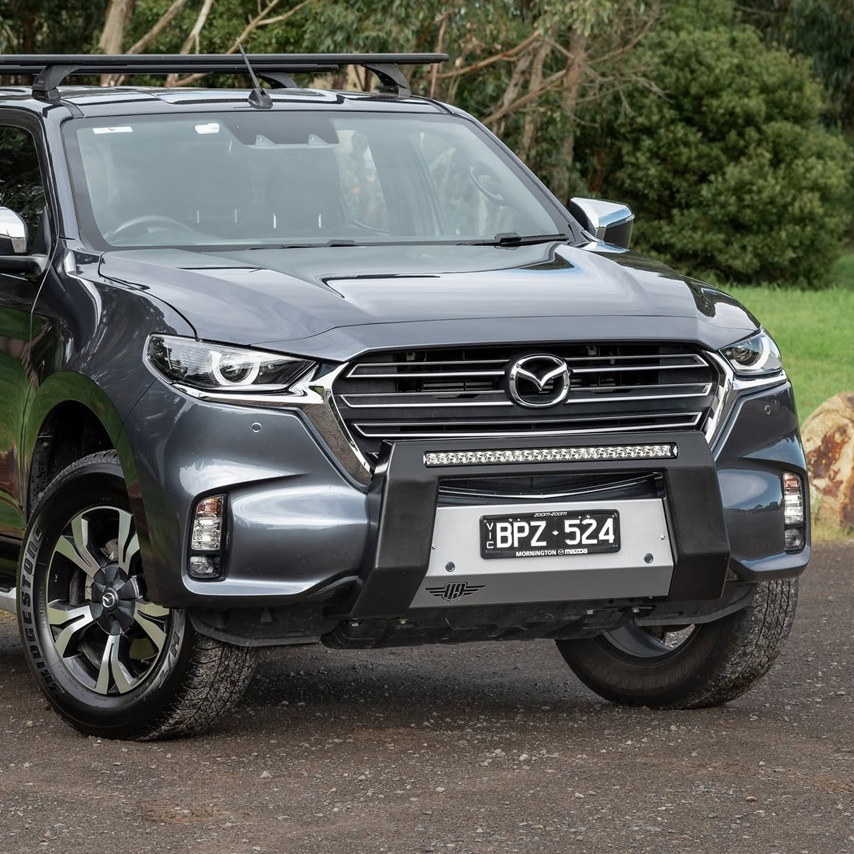
Nudge bars are lightweight, low-profile front-end accessories that mount just above the front bumper to protect the lower bumper area, number plates, and fog lights from minor impacts. They’re specifically designed for low-speed, car park bumps and light scrapes rather than major or heavy off-road use. Still, these protective additions shield critical ute components – such as grilles, radiators and parking sensor assemblies – from everyday hazards like shopping trolleys, roadside kerbs and bollards.
For BT-50 owners regularly driving on sealed roads in suburban areas, protective Mazda nudge bars additionally provide the BT-50 with a secure mounting point for common ute accessories, including driving lights, light bars and antennas without the weight and fuel penalty of full bull bars.
Build and Design Features
Aftermarket BT50 nudge bars outperform factory variants in key areas, including build quality, accessory integration and sensor and safety compatibility.
Materials and Build
Third-party manufacturers use quality Australian-sourced mild steel in thick gauges for superior strength. This is paired with 6mm steel mounting brackets and zinc or powder coating for improved corrosion and weathering resistance. By comparison, factory bars sold at Mazda dealerships are more of a cosmetic addition, with unspecified materials (often polished alloys) or undefined thickness.
Practical Features and Inclusions
Integrated LED light bars are a standard feature on aftermarket BT50 nudge bars, adding practicality and value over factory units. The additions are located within the nudge bar centre pan, provided with a matching wiring harness for easy plug-and-play connection and a dash-mounted switch. Most aftermarket nudge bars also include precision-cut mounting points for necessities like UHF and CB antennas, secondary driving lights and sand flags.
ADR Compliance and Safety Compatibility
Look for a Mazda BT50 nudge bar that meets strict Australian Design Rules (ADR) compliance. This ensures nudge bars won’t disrupt the vehicle’s safety, crashworthiness, or sensor systems. Nudge bars must not impede airbag activation in the event of collisions, have no unnecessary protrusions or sharp edges that can increase injury severity for pedestrians on impact, and ensure factory safety systems, including cameras, sensors and cruise control, work as needed. Mounted, they cannot obstruct headlight, number plates or indicators and remain within the legal width and length defined for the BT-50.
Who are Nudge Bars For?
Nudge bars provide adequate protection for your BT-50 in car parks, on worksites and confined urban settings. The additions are practical protective necessities for tradespeople working on busy city streets, where utility vehicles are constantly manoeuvring around other vehicles, equipment, and structures. For drivers in regional areas, nudge bars offer a reasonable level of protection in incidental impact, keeping shrubs, branches and spraying gravel clear of the engine and paintwork without the added weight or cost of full single or triple-hoop bull bar.
When to Choose a Bull Bar Instead?
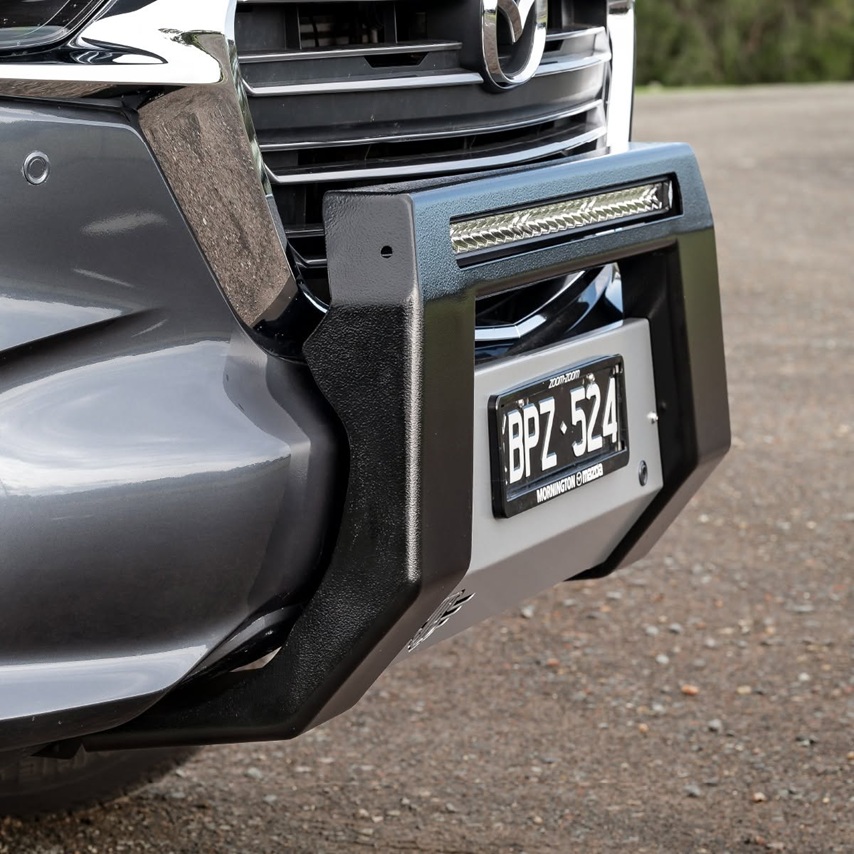
If you’re driving to the Outback on a regular basis, a bull bar is often the right choice. This protects the full width and height of your BT-50’s front end, shielding the radiator, headlights and grille from serious, high-speed impact with animals, other vehicles and larger obstacles. Bull bars use thicker steel tubing (with tubing walls between 3mm and 6mm), welded, reinforced loop sections and heavy-duty mounting hardware that secures them onto the ute chassis. This means that the front bumper needs to be removed and front safety systems relocated.
Besides the improved coverage and better build, bull bars add considerable weight. As an illustration, full triple-hoop designs can weigh up to 100 kilograms, resulting in heavier steering, front-end sag and longer braking distances. This added weight also means compromised cornering and the risk of wear to the CV joints and axles, without the weight supported by stiffer aftermarket coil springs and matching shocks. If your driving rarely means leaving city confines, then a well-built BT50 nudge is more affordable, easy to install or remove and keeps the ute closer to factory condition.
Nudge Bar Buying Considerations
When buying Mazda nudge bars, BT-50 owners prioritise protection, build, compliance and vehicle compatibility. Look for well-built, lightweight bars engineered from thicker stainless steel tubing that is also coated for added weather protection. This should shield the BT50 in everyday driving from minor impact, preventing scuffs and scratches to the bumpers and front panels.
Ensure aftermarket bars are marketed for your specific BT50 model. This rules out model variations (with current utes based on the D-Max, and previous models on the Ranger), simplifies installation and ensures a secure fit. Check that the nudge bar has undergone testing, meets ADR compliance and works with all factory safety systems. Lastly, focus on value, with bars ready to take light bars, antennas, and driving lights with appropriate mounting platforms.