
It’s a fact: at some point, anyone who’s ever worked with wood or metal has probably found themselves in a situation where having an extra gripping source would be helpful. Whether it was to hold two pieces of raw stock together or to prevent them from sliding away, the frustration that goes with chasing, balancing and even wedging working pieces together to keep them steady can take a real toll on a craftsman’s productivity and accuracy.
Clamps provide the immovable stability that’s needed for laying precise welding beads, gluing mortise and tenon joints, or simply aligning multiple sets of bore holes. And it’s no surprise that among the 30-or-so different types of clamps that are commonly used by craftsmen, that there’s one style that stands out among the rest: C type adjustable clamps.
Achieving the Safest and Securest Grip With Industrial Clamps
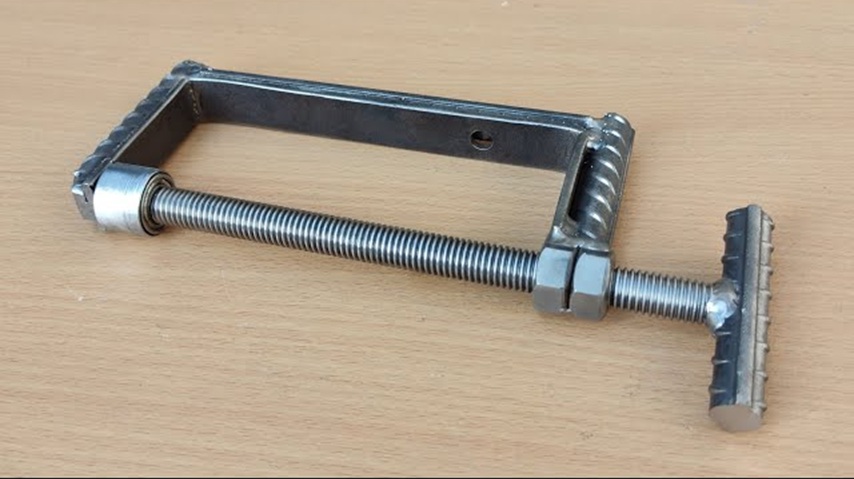
For welders, tradies and chippies of all levels, there’s no question about how important it is to always have clamps available. However, when it comes to a clamp that’s as valuable on a hobbyist’s workbench as it is on the jobsite, industrial-grade, heavy duty C clamps are the hands-down favourites.
The threaded spindle and deep vertical positioning of C clamps is perfect for applying precise holding pressure to equal points on working pieces. And for welders in particular, the ability to attach them as firmly as needed without the risk of bending or sliding away is an attribute that speaks to the most important quality: safety.
High temperatures, extreme weights and severe vibration are standard conditions for welders, brazers and other metal fabricators, making heavy duty industrial C clamps the safe clamping choice for the following reasons:
- Unmatched durability. C clamps, along with similarly designed F clamps and G clamps, made from cast or drop-forged steel, are typically nickel or chrome plated for maximum corrosion resistance and can be used in virtually any environment.
- Unrivalled clamping pressure. By design, the hardened shape and rigid threading of a screw clamp allows them to safely achieve clamping pressures to 1200kg without the prospect of splaying or flexing, regardless of the size of the working piece.
- Unbeatable simplicity. With their straightforward screw mechanisms, C, F and G type screw clamps are perfect examples of unbeatably simple and effective tools that won’t break or wear out, even under the harshest use.
The simplicity of C type clamps also means that they can be loosened and reclamped with only slight screw adjustments. That makes them beneficial timesavers for a range of welding and fabricating activities that involve multiple clamping and repositioning actions on multiple working pieces.
Specialised Screw Clamp Styles For Maximum Adjustability and Versatility
While C shaped clamp assemblies are the most commonly used industrial clamps, they’re not the only style of screw clamp that’s commercially available. The unique nature of welding and other high temperature metal-fusing activities demand a greater degree of versatility when it comes to clamping assemblies. That’s why experienced metal workers prefer to buy C clamp assemblies that are forged to handle more specialised clamping jobs.
The size and depth of a specialised clamp’s jaws, as well as the type of swivel head it has, matters as much as the amount of gripping pressure it’s able to apply. These are key attributes that specialised C clamp assemblies are based on, and are distinguishable on each of the following adjustable-styled types.
- F type clamps. Instead of the clamp’s screw mechanism being fixed to a rigid C-shaped frame, the screw mechanism on F clamps is fixed to a sliding horizontal bar, making them easier to adjust to different sizes of working pieces.
- G type clamps. Industrial G type clamp assemblies reassemble small C clamps, but their all-brass frames allow them to be used for earthing. High quality G type earth clamp assemblies are rated for amperages in the 150A – 600A range, and deliver a more positive earthing force than standard spring clamps.
- Utility type clamps. Utility clamps are also very similar to adjustable C clamp assemblies, but feature v-shaped swivel heads and removable jaws that can be used to securely clamp onto pipes or reversed to safely spread working pieces outward.
No matter the size or shape of the working piece, or the number of earthing points it needs, welders can be confident about not only finding appropriately sized C clamps for sale, but also a proper selection of specialised F, G and utility clamps. And by following a few basic rules on clamp placement and pressure, they can also be sure of achieving the best, and ultimately the safest gripping results.
Basic Clamping Precautions For Premium Clamping Results
Regardless of the kind of welding or fabricating work being performed, craftsmen always need to be mindful of the risks of applying metal C clamp assemblies too tightly. While this isn’t ordinarily a problem when working with carbon steel, the risk of crushing hollow metal tubes, and damaging the surfaces of soft-plate alloys like aluminium, brass, and copper does exist, making clamping pressure a point that shouldn’t be ignored.
Overtightening a C clamp can damage the assembly’s swivel head, driving it directly into the working piece. And where there’s application of truly excessive tightening force, the forged threads in the clamp’s frame or in the spindle can become crushed or galled, rendering the clamp unable to loosen or too dangerous to reuse.
Ideally, only as much clamping pressure as needed should ever be used with any type of clamp, and a few beneficial guidelines should be followed when applying them, to include:
- Always tightening welding C clamps gradually to avoid damaging the working piece;
- Ensuring the proper type of clamp is used when working with round or hollow, or uneven or flat working pieces; and,
- Ensuring the clamp’s face and swivel are free from any dents or damage that could affect the working surface.
The fact is, although a welder can never use too many clamps, they still only get one chance to lay a perfect bead. That makes having an appropriate number of small, medium and large C clamp assemblies on-hand the only sure way to achieve perfect positioning every time an arc is struck.
The Final Word
At the end of the day, craftsmen depend on stability for precision and personal safety – and they depend on clamps to provide the solid base they need to stay focused on doing the best job they can. Only one type of clamp, however, combines safety and stability into an assembly.
Industrial-grade, heavy duty C clamps are favoured by craftsmen because they’re simple and do the job right every time. And for welders in particular, they’re perfect for maximising productivity and accuracy.